Unlocking Creativity — How to Overcome Writer’s Block
You sit down, ready to write. You have all kinds of ideas in your head, and your fingers are on the keyboard, then suddenly… nothing. The words won’t come, the page stays blank, and what once felt exciting now feels frustrating. If you’ve ever found yourself stuck like this, you’re not alone. Writer’s block is something every author faces, but it doesn’t mean your creativity is gone. It just means it’s waiting to be unlocked. It’s a signal. It’s your mind making a shift, or a reset.
So what is writer’s block, really? Writer’s block isn’t just about not having ideas, rather it comes from several things. These could be overthinking, fear of not being “good enough”, perfectionism, burnout or mental fatigue, not knowing what comes next or what I like to call “the unknown”! If you are like me, I can tell you I can relate to all of these and sometimes more than one at the same time! But that doesn’t make us unsuccessful authors. I believe it makes us stronger authors once we recognize them in ourselves. Sometimes, these little traits (if you will) even makes us take a step back and makes our writing stronger. But how do we move past it, because our minds have a way of making us think or believe things about ourselves that necessarily aren’t true.
Understanding the cause is the first step to moving past it. We have to dig our heels in and contemplate why we can’t think of what to write andwhat it is we need to do to move past it. Most artists (yes, writer’s are artists) that I know or have read about are perfectionists. At least to a certain extent. That’s one of the reasons why we think our work (sometimes) is not “good enough.” I can totally relate to this one! I remember back when I was in college, and my Creative Writing professor gave us an assignment in which we had to write a short story. Well, my story was anything but short! It was more like a novella. (A novella is a work of fiction that is longer than a short story but shorter than a full-length novel, and you can usually read it in one sitting.) A few days later, as I was walking up the stairs to the college’s newspaper room, I could hear someone calling my name. I stopped on the stairs, looked down, and there stood my Creative Writing teacher holding this “manuscript” in her hands. She proceeded to tell me (after I apologized for it being so long because I thought she was going to tell me I failed the assignment because it wasn’t a short story) that she loved it and that I really should “get this published.” But guess what happened? I didn’t – ever! I kept editing, rewriting, editing, and occasionally, as I got older, I would take it out of a folder, reread it, shake my head nope, and put it away. I never thought it was “good enough”. But why did I not think it was good enough? Lack of confidence? Eh, maybe. Afraid of the unknown? A little. Not knowing how to get it published? Possibly.
Looking back now, though, I think it was that pesky little perfection trait and not being able to let it go. One of the biggest reasons writers get stuck is the pressure to write something perfect the first time. But as we all know, this is not only unrealistic but also doesn’t happen in the world of writing books. It’s a lie our minds trick us into believing. But the truth is, your first draft is not meant to be perfect, but rather it’s meant to exist. I wish I had known that back in those college days. Give yourself permission to write messy. In other words, many authors just start writing without really thinking too much about what they are writing. Some of the best stories start as rough ideas that are later refined. Progress matters more than perfection.
The next thing to do in overcoming writer’s block is to start small. Sometimes writing a full chapter, or even a few pages if it’s a children’s book, might feel overwhelming, so scale it back. Try starting by writing just one paragraph. You can always keep going if you feel your writer’s block is slipping away and you’re getting those creative juices flowing again. Or, describe one scene or write a conversation between two characters. The key is that small steps build momentum. Once you begin, it often becomes easier to keep going.
Another thing you can do is to revisit your “why.” Ask yourself, “Why did I start writing this story in the first place?” Was it because there was a message you wanted to share, a story you couldn’t get to leave your brain, or was it a desire to inspire or teach? Sometimes, when we reconnect with our purpose, it can reignite our motivation and remind us why our story matters.
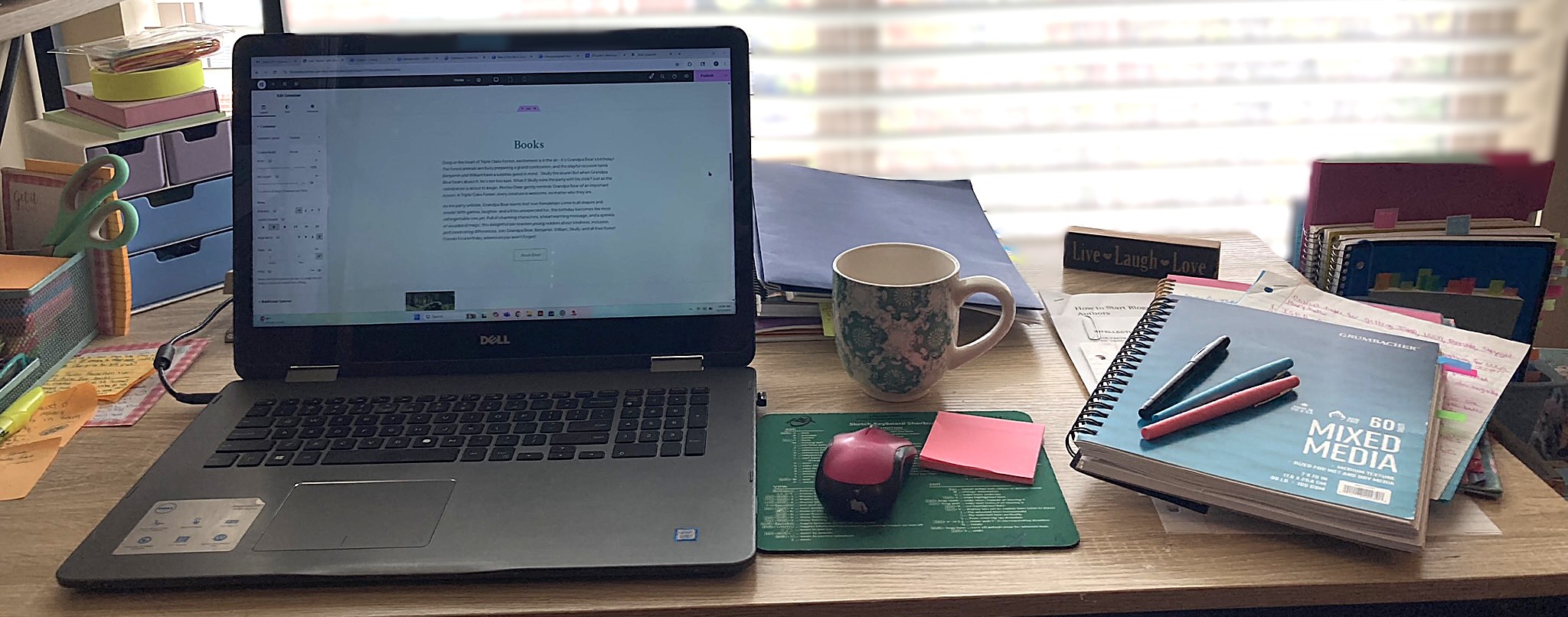
Making a change in our environment sometimes is the key to getting rid of writer’s block. A change of scenery makes a big difference. Maybe try writing in a different room than you normally write in, go to a coffee shop or library, or take your laptop outside. Changing our environment and writing some place we do not normally write can help refresh our minds and even spark new ideas. And sometimes, it’s about letting yourself take a break without throwing in the towel and quitting completely. There is a difference between stepping away from a break and giving up. For instance, go for a walk, listen to some music, or read a book. In my experience, ideas often come when I am not trying to force them. (For me, unfortunately, these ideas usually come to me when I am trying to go to sleep!)
Sometimes, authors will use prompts or questions if they are still feeling stuck and unsure as to what to write next. Some questions to think about are: What does my character want right now? What problem can I introduce? What happens next – is it something unexpected? Just like writing the first draft doesn’t have to be perfect, you don’t need the perfect answer. You just need a direction.
Have you ever heard of actors rehearsing their lines out loud? They do this so that they can organize their thoughts as to how they are going to respond to the other character(s), or how they are going to react, etc. Authors can do the same thing. Saying your ideas out loud can help you organize your thoughts, too. There are several ways this can be done. Explain your story or ideas to a friend and listen to yourself as you are doing this. You can also record yourself talking through your ideas. Then, play it back and listen to what your ideas are. Sometimes this sparks more ideas, and sometimes you think to yourself (after hearing the ideas out loud), what was I thinking? That idea is horrible! Or, you can teach your story as if you are explaining it to someone else. Doing these can help you unlock thoughts that feel stuck on the page.
An important thing to remember is that you are not alone. Every writer experiences writer’s block at some point in the writing process. It doesn’t mean you are not creative, or that your story isn’t worth telling. It just means you are in the process. It is a pause, and sometimes that pause is just what you need to begin again stronger, clearer, and even more inspired. Know this and repeat it to yourself, or write it on a sticky note where you can see it to remind yourself – my story is still there. My ideas are still valid. My voice still matters. And above all, give yourself grace. Take a breath, start where you can, and keep moving forward one word at a time.